Every chair on this page has a list price printed beside it that it barely ever sells at. One of them advertises against a figure of $239.88 and was selling at $189.96 the day we checked. Another carries a number it has not touched in three months.
So we did something different from the usual ranking. We pulled the recorded selling price of seven of the most widely owned ergonomic chairs on Amazon US, day by day, for the period from June 27 through September 25, 2026, covering 91 calendar dates, and looked at the shape of each price curve instead of the size of each discount.
The result is lopsided in a way we did not expect: not one of the seven is anywhere near the middle of its own price range. Four are sitting on their 90-day floor. Three are on their 90-day ceiling. Nothing is in between — and that, it turns out, is the most useful thing on this page.
How we researched this guide
Refer a Deal is a research desk, not a test lab. We do not claim to have used the chairs on this page, and nothing here is written as if we did.
What we did instead: pulled the daily recorded selling price for each of the seven models across a 90-day window; noted which of those days Amazon itself marked as a promotion; read the manufacturer documentation for each model; and worked through the one- and two-star reviews on the listings to see what owners report going wrong, and at what age. Every figure below traces back to one of those sources. Where the data has a hole in it, we say so rather than closing the gap.
This is not a feature comparison. Which chair suits which body is a real question, and a specification table is where you answer it. This guide answers the other half of the decision: at the price each of these is asking today, is now a good moment to buy it?
The full method, and what this site will not do, is on Our method.
Why a price history beats a discount badge
A discount percentage compares two numbers that the seller chooses. A price history is a record of what the listing actually showed, day after day. Three things fall out of the second one that you cannot get from the first.
The list price is decoration. The SIHOO M57 lists at $239.88. Across 90 days it appears at that figure exactly four times — each time for a single day, like a price tag left in the window. Every other day of the quarter it sold for $189.96 to $199.99. A “save 21%” badge computed against $239.88 is describing a price nobody paid.
A low price is only good news if it is unusual. This is the part a percentage can never tell you. If a chair reaches $169.99 in three separate weeks of a quarter, that figure is not a sale — it is the second of its two prices, and the only thing you have learned is which of the two you happen to be looking at. Four of the seven chairs below are in exactly this position today.
The expensive mistake is buying at the peak, and the peak is visible from here. Two of the chairs below have not run a single promotion in 90 days, and both are currently at their highest recorded price. That is not a hidden fact. It is sitting in the price record, and it is the single most valuable thing a buyer can know.
The seven chairs at a glance
| Chair | Today | 90-day low | 90-day average | 90-day high | Where today sits |
|---|---|---|---|---|---|
| SIHOO M18 | $132.53 | $132.53 | $141.32 | $169.99 | 0% — its floor |
| SIHOO M57 | $189.96 | $189.96 | $197.95 | $239.88 | 0% — its floor |
| CLOUVOU | $169.99 | $169.98 | $187.52 | $199.99 | 0% — its floor |
| NOBLEWELL | $109.99 | $109.98 | $110.66 | $129.99 | 0% — its floor |
| Hbada | $129.99 | $94.99 | $102.26 | $129.99 | 100% — its ceiling |
| Ticova | $139.99 | $119.99 | $135.61 | $139.99 | 100% — its ceiling |
| Duramont | $299.98 | $198.99 | $254.56 | $299.98 | 100% — its ceiling |
“Where today sits” is the current price as a position within the model’s own 90-day range: 0% means it has never been cheaper in the window, 100% means it has never been more expensive. Prices and ratings are as of 25 September 2026.
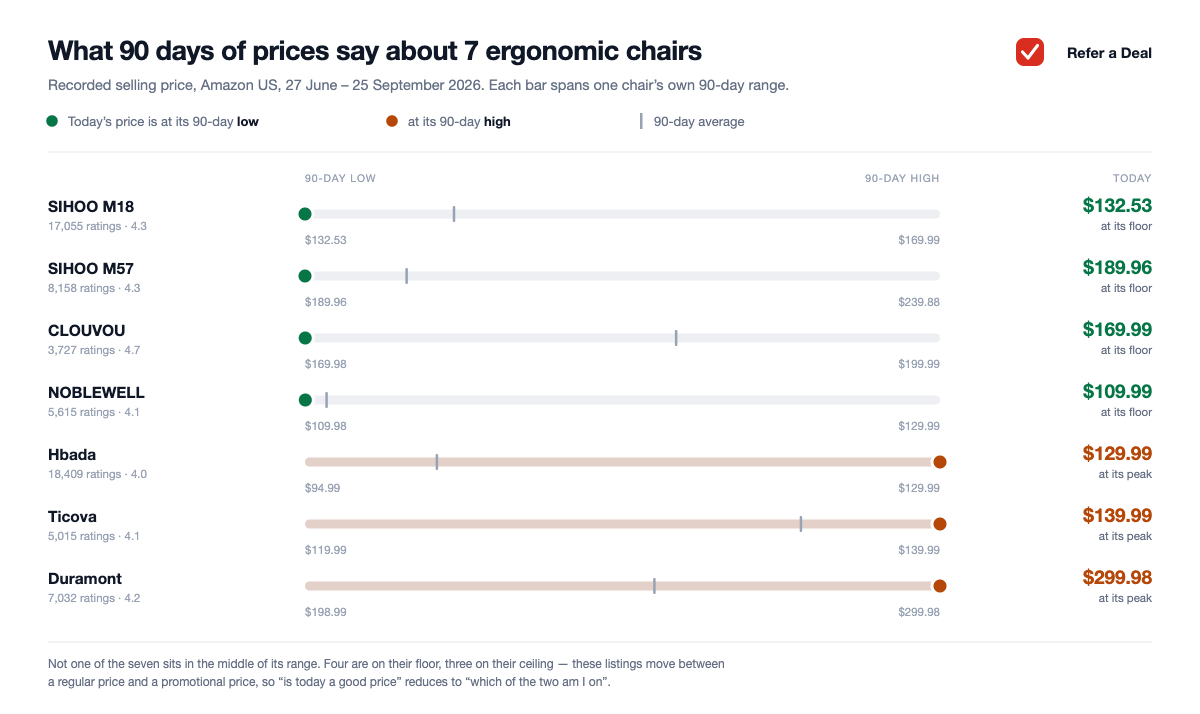
Nothing in this group is at 20% or 60%. Every one of them is pinned to an extreme. That is not a coincidence of our shortlist — it is how these listings work. A seller sets a regular price and a promotional price and moves between the two. There is no smooth curve for a price history to sit on the middle of.
The four sitting on their floor
All four of these are at the lowest price they have shown in three months. That does not make them equal, because they got there in three completely different ways — and the difference decides whether you should buy today or wait for a better version of the same event.
SIHOO M18 — $132.53, and the floor is a real event
This is the one in this guide where the price data and the deal data agree. Over 90 days the M18 spent 30 days at $132.53, in three separate blocks: 18–27 July, 17–30 August, and 20–25 September. Of those 30 days, 29 carried Amazon’s promotional flag.
The rest of the time it sits at $146.99, which is where it spent 37 of the 91 days — more than at any other figure. It touches its $169.99 list price on exactly four isolated days, the last on 19 September.
So the shape is: a regular price of $146.99, a promotional price of $132.53, and a floor that recurs roughly every four to five weeks. The previous two windows ran 10 days and 14 days. The current one is six days old.
There is one detail worth knowing before you treat these as two independent sales. The SIHOO M57 below ran its promotional windows on almost the same dates — 17–30 August for both models, and the last week of September for both. Whatever drives this, it is a brand-level calendar rather than a reaction to demand on one listing.
At 17,055 ratings and 4.3 stars, this is also the most-owned chair in the group after the Hbada, which matters for a reason covered further down: ownership is where long-term failure patterns come from.
SIHOO M18 — check today’s price on Amazon →
SIHOO M57 — $189.96, the same shape one tier up
The M57 behaves like its sibling with the numbers shifted. It has two working prices: $199.99, which it held for 51 of the 91 days, and a band of $189.96 to $189.99 — the three figures differ by cents and are functionally one price — which it held for 36 days. Today it is on the lower one, and 32 of those days carried a promotion flag.
Both SIHOO models were near their observed lows on September 25, 2026. The M57 spent 36 of the 91 calendar days in its $189.96–$189.99 lower-price band, compared with 30 days at $132.53 for the M18. On those definitions, the M57’s lower-price band appeared more often, not less. The comparison is approximate because the M57 count groups several prices within a three-cent range, while the M18 count uses one exact price. These observations describe the historical window; they do not predict when either chair will next go on sale.
One caveat if you see a headline discount on this listing. The $239.88 that appears in its own marketing is the list price, and in 90 days it held for four single days.
SIHOO M57 — check today’s price on Amazon →
CLOUVOU — $169.99, where the low price is not a sale
This is the best-rated chair in the guide: 4.7 stars across 3,727 ratings, the highest average of the seven by a clear margin. It is also the cleanest illustration of the two-price problem.
Over 90 days the CLOUVOU moved between $199.99 (52 days) and $169.99 (38 days). The lower figure was reached in five separate stretches — 8–15 July, 14–27 August, 7–11 September, and 14–25 September among them — and only about 16 of those 38 days carried a promotion flag. The rest of the time it was simply the price.
Read that carefully, because it is the difference between this guide and a discount round-up. When a listing reaches the same number with a promotion flag and without one, that number is not a sale price. It is the second of two regular prices, and it appears every few weeks regardless of whether anybody is running a promotion.
Buying at $169.99 is not a mistake — it is the better of the two prices, and the alternative is $199.99. But it is not a discount, and nobody should feel rushed into it.
CLOUVOU — check today’s price on Amazon →
NOBLEWELL — $109.99, the clearest proof that a deal flag means nothing
The NOBLEWELL barely has a price history. Of 91 days, 88 sat at $109.99 or $109.98 — a difference of one cent. It touched $129.99 on three days: 30 August, and 6–7 September. That is the entire range of movement in a quarter.
Now the part that ought to change how you read every deal badge on Amazon. The three days that carried a promotional flag on this listing were 20–22 July, when the price was $109.98. Amazon marked down a chair by one cent and flagged it as a promotion.
We are not suggesting the flag was placed in bad faith — the listing was running a separate multi-buy promotion that week. The point is narrower and more useful: a deal flag tells you a promotional price was configured, not that the price is good. The only way to know whether a price is good is to look at the price history behind it.
Practically, this makes the NOBLEWELL the simplest decision in the guide. There is no window to wait for, because the price does not move. If it fits your budget and your body, the day you buy it makes no difference.
NOBLEWELL — check today’s price on Amazon →
The three at their ceiling
These are the three where waiting is the answer. Each is at the highest price it has shown in 90 days, and in two of the three cases there is no evidence in the record of a promotion at all.
Hbada — up 37% from its floor, and the data has a hole in it
For six weeks this was the cheapest chair in the group. From 30 June to 10 August the Hbada sat at $94.99 — 41 observed days, interrupted on 5 August by a single day at $129.99.
Then, on 11 August, it moved to $129.99. In every day since that has data, it has not gone back.
Here we have to be straight about a limitation, because it changes how much weight the second half of that sentence can carry. The Hbada listing has no recorded price on 35 of the 91 days — 18–22 August, then a 29-day run from 25 August to 22 September, and 25 September itself. The claim that it never returned to $94.99 therefore rests on twelve observed days spread across the last six weeks, not on continuous evidence. We can say with confidence that $94.99 was its price through early August. We cannot rule out a brief return that the record missed.
What is not in doubt: the price has not run a single promotion-flagged day in the entire window, and today’s $129.99 is the highest figure it has recorded. If you want this chair, $95 is the price the record says to wait for.
Hbada — check today’s price on Amazon →
Ticova — up 17%, and frozen at the top for 53 days
The Ticova moved in one direction and then stopped. It began the window at $119.99 for a single day on 27 June, settled at $129.99 for 37 days, and on 4 August rose to $139.99. It has stayed at $139.99 for the 53 days since.
Two things make this the least promising chair in the guide to wait on. First, it is at its 90-day high right now. Second, the staircase only ever went up: there is no instance in the record of it coming back down. And like the Hbada, it has recorded no promotional days at all in 90 days.
Five thousand ratings at 4.1 stars put it in the middle of the group on owner sentiment. On price, it is at the worst point in the window.
Ticova — check today’s price on Amazon →
Duramont — up 51% in eleven days
This one moved the fastest and the furthest. For most of the quarter the Duramont lived between $198.99 and $289.98, and it was on its floor as recently as 11 September. On 12 September it moved to $279.46. From 13 September to today it has been $299.98.
That is the highest price the listing has shown in 90 days, reached eleven days ago from a base of $198.99 — a 51% move. It is also, on this data, the single worst moment in the quarter to buy this chair.
One honest qualification. The Duramont listing has carried a coupon through most of this period, typically $75 to $80 off at checkout, so the amount actually charged has been below the recorded price throughout. That discount is real. But it was equally real in June, when the recorded price was $100 lower, so it does not make today any better than it was then.
Duramont — check today’s price on Amazon →
What owners report: the SIHOO M18
Price tells you when to buy. Reviews tell you what you are buying, and the two-star reviews are where the useful part lives — ratings tell you how people felt, the text tells you what broke.
The M18 listing carries 520 one- and two-star ratings. We read the twenty most recent. One of those twenty turns out to be reviewing a different SIHOO chair, so the counts below cover 19 relevant reviews. It is a small sample and we are labelling it as one, but the complaints are not scattered — they cluster.
| What was reported | Among 19 relevant reviews from the 20 most recent 1–2-star reviews examined |
|---|---|
| Armrest problems — hard, loose, detaching, or surface peeling | 8 |
| Assembly difficulty and unhelpful instructions | 6 |
| Seat too hard, pressure points in long sitting | 5 |
| Durability — mechanism or armrest failure inside two years | 4 |
| Size and fit — too small for taller buyers, headrest too high | 4 |
| Wobble, looseness, or noise developing over months | 3 |
| Lumbar support sits too low | 2 |
| Support unresponsive when contacted | 2 |
Three of these patterns are worth naming, because they are the ones buyers do not see coming:
1. The armrests are the weakest part of the chair, not the seat or the gas lift. Armrest complaints outnumber every other category in the sample, and they split between two failure modes: the padding hardening and peeling, and the mount working loose or cracking. One owner describes both armrests failing in sequence within about eighteen months.
2. Assembly is a genuine inconvenience, not a formality. Owners report an hour and a half to two hours, and the recurring complaint is the illustrations rather than the hardware — several describe having to identify parts by elimination. If you are buying this for someone who would find that frustrating, that is worth knowing before it arrives.
3. Fit is the reason people return it. Four reviews are from buyers above roughly 5′10″ or with a larger frame who found the chair too small, and the headrest position recurs. This is consistent with the model being a mid-size design, and it is the one thing here that no price data can answer for you.
These findings describe recurring complaints within 19 relevant low-rated reviews, not the experience of all SIHOO M18 buyers. The listing’s overall rating summarizes submitted ratings; it does not establish how many chairs developed faults. This small, deliberately selected sample can highlight issues worth checking before purchase, but it cannot estimate the chair’s failure rate or typical service life.
Where these numbers come from
- Prices — the daily recorded selling price for each model across the period from June 27 through September 25, 2026, covering 91 calendar dates, taken from a price-history feed that logs the figure each listing actually displayed. Not list prices, and not the crossed-out figures on the listings.
- Promotion flags — whether Amazon itself marked the listing as a promotion on that day. Counted by day, not inferred from the size of a price move.
- Ownership — the ratings count on each Amazon listing, which we treat as a rough proxy for how many people own the model.
- Owner reports — the one- and two-star reviews on the SIHOO M18 listing, read and counted by subject rather than quoted selectively. The sample size is stated where we quote a number.
- Missing data — where a listing has days with no recorded price, we say so in the text and do not interpolate across the gap. The Hbada figure in this guide has 35 such days.
Prices move, and a guide that describes a price is only as good as its date. Every figure here was taken on 25 September 2026.
How to read a price history yourself
The method is not proprietary, and you can apply it to any listing in a few minutes with a price-history tool.
Ignore the list price entirely
It is a number the seller sets and can change. In this guide, one of them appeared for four days out of ninety. Comparing a current price to it tells you nothing about whether today is a good day to buy.
Compare the price to its own range, never to another product’s
The question is not “is $170 cheap for an ergonomic chair”. It is “is $170 cheap for this chair, and how often is it $170”.
Then ask how often the low happens
This is the step almost everyone skips, and it is the one that separates a discount from a second regular price. Once a quarter is a sale. Every five weeks, with no promotion flag, is just the price.
Measure the range in days, not dollars
The NOBLEWELL shows an 18% gap between its 90-day low and high, which sounds like a volatile listing worth timing. It reached the high on three days. A percentage built from outliers describes a market that does not exist.
Check the direction of the last move
A price that stepped up and has held for a month is unlikely to step back down on its own. Both the Ticova and the Duramont are in that position, and it is the reason we would not wait on either.
What we would buy
If we needed a chair for a home desk this week, the SIHOO M18 at $132.53 is the recommendation, and the reason is not that it is the cheapest. It is the only model here whose low price is both genuine and finite: Amazon flagged it as a promotion on 29 of the days it appeared, it has occurred three times in a quarter, and the previous two windows lasted 10 and 14 days. The current one is six days old. Its rating base of 17,055 owners is also large enough to mean something.
If you want the best-rated chair of the seven and are not in a hurry, the CLOUVOU at $169.99 is a defensible buy today — 4.7 stars is the highest average in the group by a wide margin. Just be clear about what you are doing: you are taking the lower of its two regular prices, not a discount.
If you can wait, the honest answer is that three of these chairs are at their 90-day peak today. The Duramont is $101 above where it sat eleven days ago. The Hbada is $35 above its own floor. The Ticova has not moved off its high in 53 days and has never once come back down within the window. Buying any of the three today means paying the most the listing has asked in three months.
And one thing not to do: do not wait for the SIHOO M18 to fall below $132.53. Across 91 days it has not, and the price band it alternates with is $146.99 — fourteen dollars higher.
Check the SIHOO M18 price on Amazon →
Frequently asked
Why is one ergonomic chair $110 and another $300?
Mostly the adjustment mechanisms and the material quality around the seat, not the frame. What the price data adds is that the gap within a single model’s own range can be as large as the gap between models — the Duramont moved $101 in eleven days. Buying at the right moment within one model can be worth more than switching models.
Is $132 a suspiciously low price for an ergonomic chair?
Not on this evidence. The M18’s low price is a recurring promotional tier on a listing with 17,055 ratings and a 4.3-star average, not a clearance, a return, or a discontinued variant. The owner complaints it does attract — armrests, assembly, fit — are the normal trade-offs at this price rather than signs of a bad batch.
Should I wait for the chairs that are at their peak?
Two of the three have recorded no promotional days at all in 90 days, so there is no recurring window to wait for. The Duramont does discount, and it was on its floor as recently as 11 September, so a patient buyer has a real reason to hold — though a 90-day window is short, and it is the only evidence we have.
Related: for what actually breaks on these chairs over time, see our ergonomic chair reliability study.